About 90% of YouTube channels never reach 1,000 subscribers, which means only 10% cross that line, according to this YouTube growth breakdown. That number changes the question.
The key question isn't just how to get 1000 subs on YouTube. It's how to build a channel system strong enough to survive long enough, publish often enough, and convert well enough to join the small group that does.
Most creators don't fail because they picked the wrong dream. They fail because they built a channel on bursts of effort instead of a repeatable production engine. One good idea, one polished upload, or one lucky Short rarely carries a new channel to the finish line. A system does.
Table of Contents
- Laying the Foundation Your Niche and Content Pillars
- Building Your Content Engine A Repeatable Publishing System
- Optimizing for Discovery SEO and Clickable Thumbnails
- The Growth Multiplier Shorts and Community Engagement
- Scaling Your Production to Maintain Quality and Consistency
- Tracking Progress and Crossing the 1000 Subscriber Finish Line
Laying the Foundation Your Niche and Content Pillars
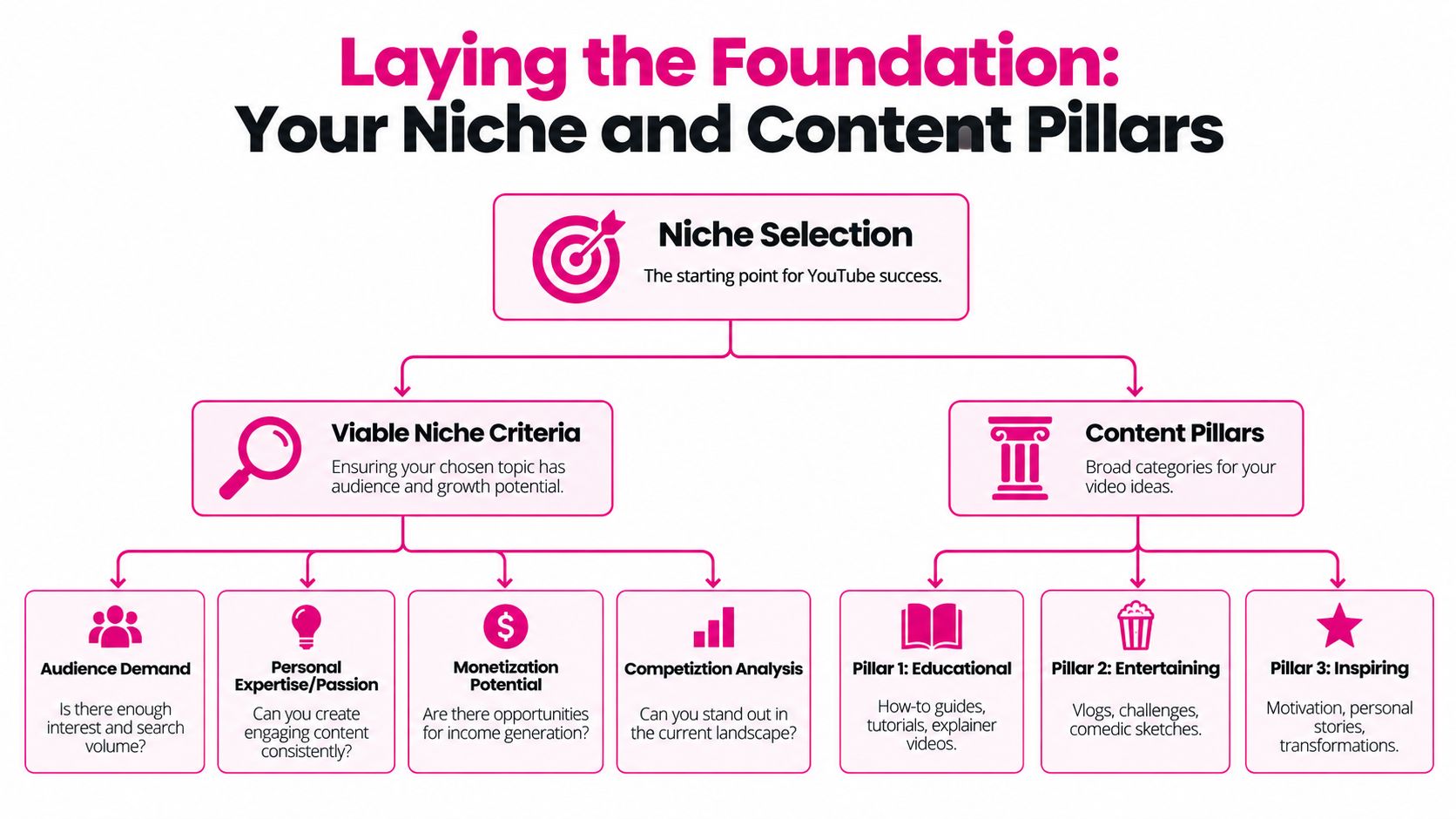
A niche isn't a topic. It's a specific audience with a repeatable problem, desire, or identity.
"Fitness" is a topic. "Busy parents who want short home workouts" is a niche. "Photography" is a topic. "Beginner real estate agents who need better property video" is a niche. The narrower version gives you a clearer promise, better titles, and a much easier time earning a subscribe.
One of the most useful ways to validate a niche is to look for market inefficiencies. A strong benchmark is finding videos from channels under 100,000 subscribers that earned at least five times more views than their subscriber count, which signals strong demand with a lower barrier for newer creators, based on this YouTube strategy explanation.
Define the audience before the format
Start with four filters:
- Who are they: Name the viewer in plain language. Beginner coders, first-time founders, teachers using AI, new dads learning meal prep.
- What do they want: Focus on an outcome, not just interest. Save time, get clients, learn a skill, avoid mistakes.
- What will you repeatedly help with: Pick a problem you can solve more than once without running out of angles.
- Why should they trust you: Experience matters, but clarity matters more. You don't need celebrity authority. You need usable insight.
If you're still broad, you're still guessing.
A useful exercise is to write one sentence: "This channel helps [audience] get [result] through [type of content]." If that sentence sounds fuzzy, the channel will too.
Build three to five content pillars
The best early channels don't chase random ideas. They choose three to five core pillars and stay inside them long enough for YouTube and viewers to understand what the channel is about.
A practical setup looks like this:
| Pillar | What it covers | Why it works |
|---|---|---|
| Tutorials | Step-by-step how-to videos | Pulls in search-driven viewers |
| Mistake breakdowns | What to avoid, what to fix | Creates urgency and relevance |
| Tool or workflow reviews | Software, gear, systems | Attracts decision-stage viewers |
| Case reactions | Breakdowns of good and bad examples | Makes expertise visible |
| Q&A content | Specific audience questions | Turns comments into ideas |
Practical rule: If a video doesn't clearly fit one of your pillars, it usually weakens channel positioning.
Creators who want extra validation can compare niches using a more commercial lens, especially if they want to align growth with revenue potential. This guide on profitable YouTube niches is useful for checking whether your topic has room to grow as a business, not just as a hobby.
Use proof, not passion alone
Passion helps you stay in the game. It doesn't replace evidence.
Before committing to a niche, search YouTube like a viewer would. Look at titles, thumbnails, and comment sections. If small or mid-sized channels are getting traction on repeatable subtopics, that's a positive sign. If every successful result is dominated by giant channels and you can't find any angle they ignore, you'll need a narrower audience or a sharper promise.
The best niche choice feels slightly restrictive at first. That's usually a good sign. Clear channels grow faster than scattered ones.
Building Your Content Engine A Repeatable Publishing System
Most creators hear "be consistent" and translate it into "post more." That's too vague to be useful.
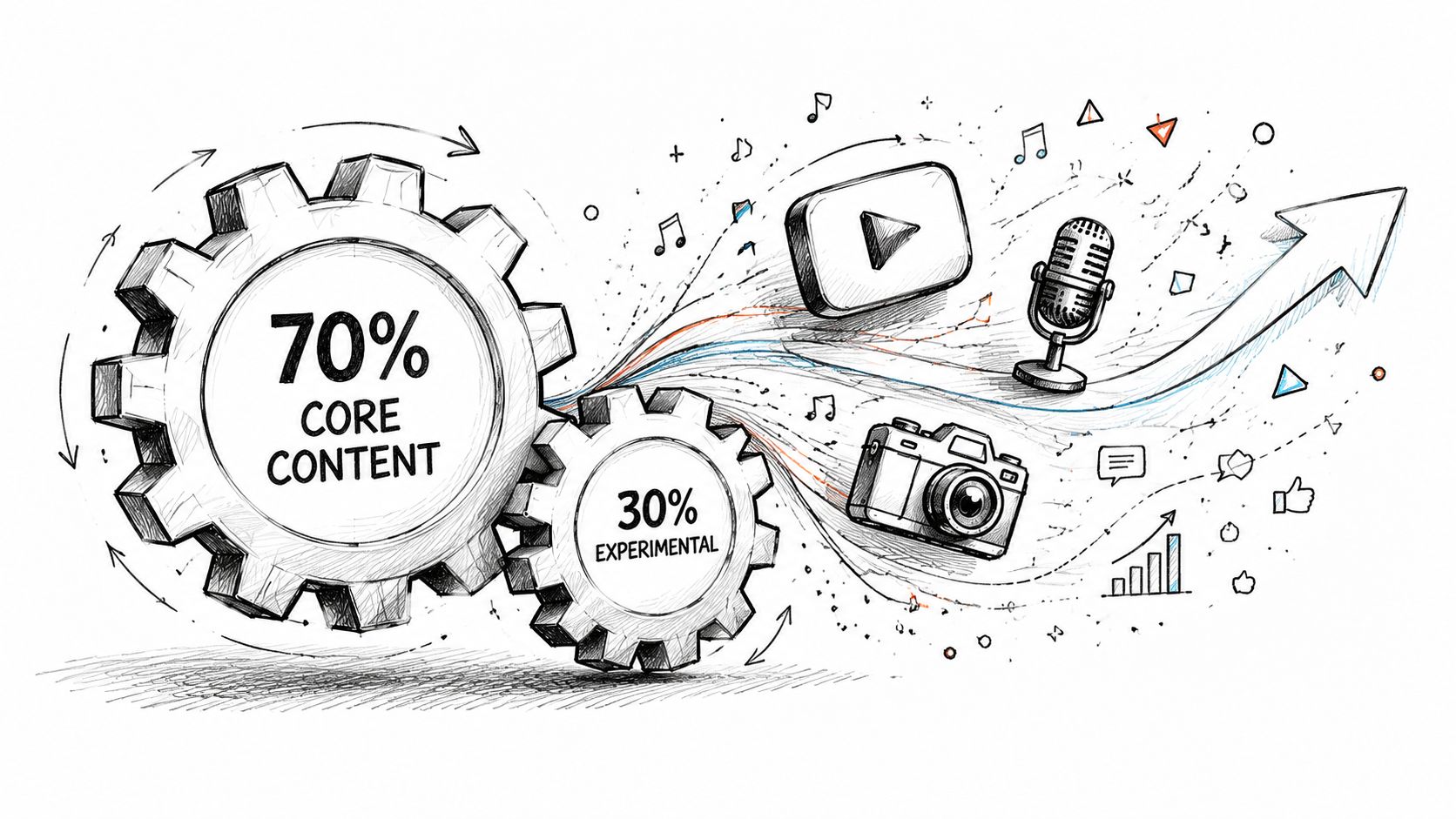
A content engine works when it tells you what to make, in what ratio, on what cadence, and how each asset supports the others. One proven structure is to publish one focused long-form video each week, supported by two companion Shorts and one Community post, while using the 70/30 Rule. Model 70% of your content on proven formats in your niche and use 30% for experimentation, as outlined in this vidIQ guide to first 1,000 subscribers.
Turn the weekly stack into one workflow
Don't treat long-form, Shorts, and community updates as separate jobs. Treat them as outputs from one production cycle.
Here's what that looks like in practice:
- Choose one core topic: Pick a video with a clear outcome. "How to light talking-head videos in a small room" is stronger than "lighting tips."
- Write for long-form first: Build the main video around one problem and one promised result.
- Extract two Shorts from the same idea: One can be a tight clip. The other can be a native vertical version with a different hook.
- Publish one Community post tied to the topic: Ask a question, run a poll, or tease the lesson.
- Use each asset to push toward the next one: Shorts point to the long video. The long video points to the next related video. The Community post revives interest.
That structure reduces decision fatigue. You're not inventing four content ideas. You're developing one idea fully.
The 70/30 Rule keeps creativity under control
Many new channels make one of two mistakes. They either copy everything in the niche and become forgettable, or they try to be wildly original before they've learned what viewers already want.
The 70/30 Rule fixes that tension.
- The 70% side: Study channels that are much bigger than yours but still close enough to compare. Look at recurring title patterns, thumbnail framing, video openings, and pacing choices.
- The 30% side: Test your own angle. Change the framing, delivery style, visual style, or audience segment.
- The key decision: Borrow the structure, not the identity.
If you can't produce your schedule for the next two months without burning out, it's not a strategy. It's a sprint.
A weekly rhythm like this is easier to sustain when the operational work is organized. Teams and solo creators alike often benefit from a documented process for planning, editing, approvals, and publishing. This breakdown of YouTube video management is a useful reference for what a structured pipeline includes.
What doesn't work
A few patterns stall channels early:
| Common move | Why it fails |
|---|---|
| Uploading randomly | YouTube and viewers can't recognize your pattern |
| Reinventing every video style | Production gets slower and branding gets weaker |
| Chasing trends outside your niche | You may get views without building the right audience |
| Posting only when inspiration hits | Gaps break momentum and learning cycles |
The goal isn't volume for its own sake. It's repeatable output with consistent quality and clear positioning. That's what gives a new channel enough surface area to learn.
Optimizing for Discovery SEO and Clickable Thumbnails
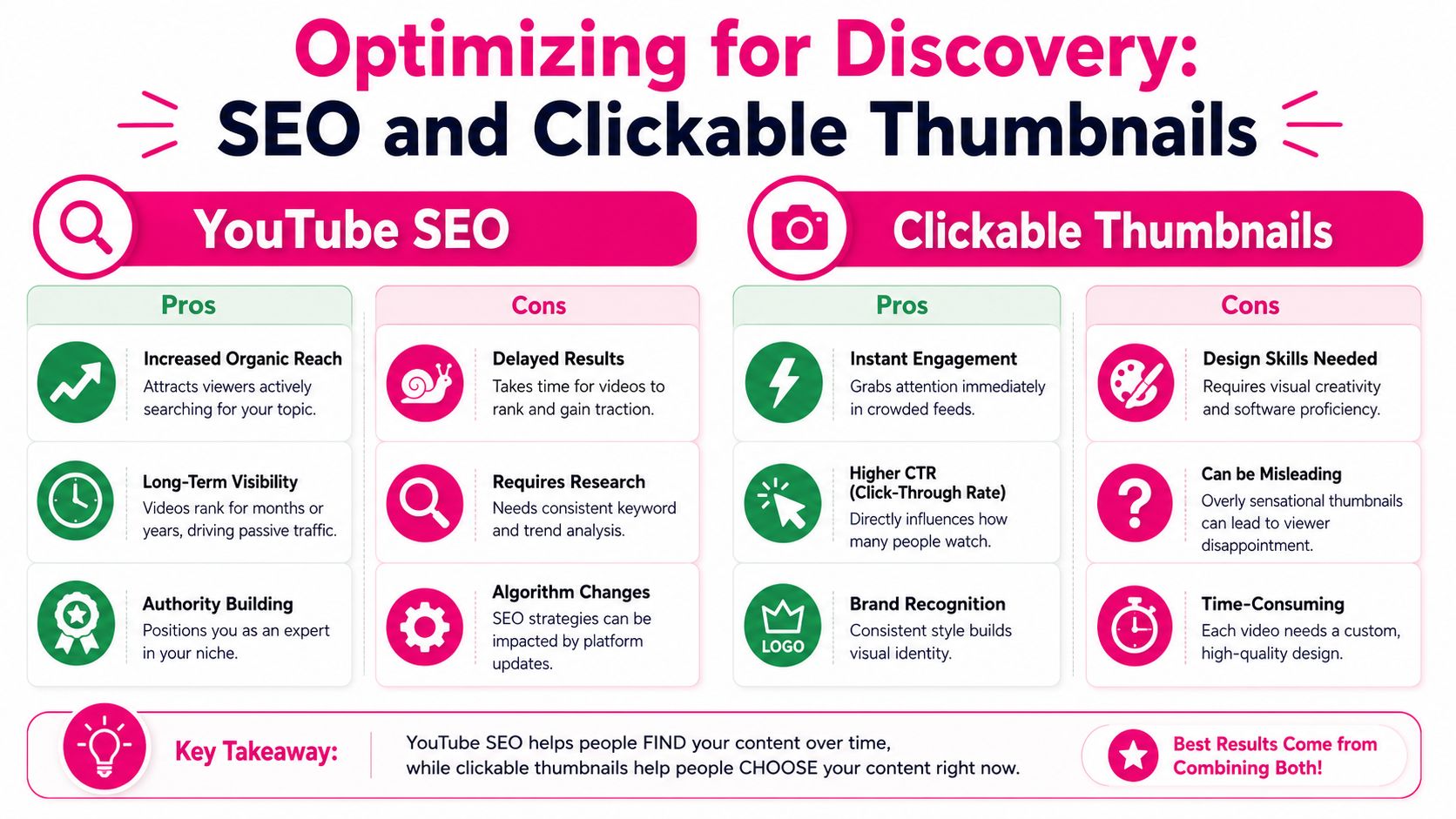
A good video can still fail if nobody clicks it. On YouTube, discovery usually starts with packaging.
Titles and thumbnails do different jobs. A title carries the promise. A thumbnail carries the emotional signal. When they work together, the viewer understands both what they'll get and why they should care now.
Make the title do one job well
Weak titles often try to sound clever. Strong titles make a clear promise.
Compare the difference:
| Weak | Better |
|---|---|
| My YouTube Journey So Far | I Posted Weekly on YouTube and Learned This |
| Editing Tips for Beginners | 5 Editing Mistakes That Make Videos Feel Amateur |
| How I Organize My Videos | My Simple YouTube Workflow for Faster Weekly Uploads |
The stronger versions create clarity, tension, or an implied result. They also align better with how people browse. A viewer doesn't care that you made a video. They care whether that video solves something for them.
For channels that want stronger search positioning, metadata still matters. Titles, descriptions, tags, playlists, and topical consistency help YouTube understand what the content is about. A practical reference for that side of the equation is this guide to YouTube SEO.
Thumbnails carry the emotional payload
A thumbnail should be understandable at mobile size. If the idea only works when the image is large, it's too complicated.
Use a quick test before publishing:
- Clarity: Can someone understand the basic idea in a glance?
- Contrast: Does the subject stand out from the background?
- Focus: Is there one dominant visual idea, not five?
- Consistency: Does it feel like it belongs to your channel?
A few thumbnail directions tend to work better than cluttered designs:
- Face plus reaction: Best when emotion is relevant to the payoff.
- Object or interface close-up: Good for tool reviews and tutorials.
- Before and after framing: Strong when transformation is central.
- Minimal text: Useful only if the text adds what the image can't.
A thumbnail doesn't need to explain the whole video. It needs to create enough certainty and curiosity for the click.
This breakdown is worth watching if you want a deeper sense of what makes packaging more clickable:
SEO and click psychology work together
Creators often separate search strategy from visual packaging. Viewers don't. They see one complete pitch.
If your title promises a concrete outcome but the thumbnail feels vague, the package weakens. If the thumbnail is dramatic but the title is generic, the package weakens. The strongest videos match all three layers:
- Topic fit: It matches what the audience already wants.
- Search language: The wording reflects how people think or search.
- Visual trigger: The thumbnail makes the promise feel immediate.
That balance matters more than stuffing keywords into every field. You aren't trying to outsmart YouTube. You're trying to make the value obvious fast.
The Growth Multiplier Shorts and Community Engagement
Shorts are excellent at getting discovered. They're much worse at closing the subscription decision on their own.
That's why so many creators say, "My Shorts get views, but I don't get subscribers." The problem usually isn't reach. It's routing. According to this YouTube analysis of Shorts-to-long-form conversion, Shorts can generate large view counts but convert at under 1% to long-form subscribers unless creators deliberately use bridging tactics such as pinned comments, end screens, and curiosity hooks.
Treat Shorts as the top of the funnel
A Short should do one of three things:
- Open a loop: Introduce a problem, mistake, or surprising result.
- Preview a payoff: Show a snippet that makes the full explanation feel worth watching.
- Qualify the viewer: Attract the exact kind of person your long-form content serves.
That means the Short itself shouldn't try to do everything. If it teaches the entire lesson with no next step, you've probably ended the relationship at the point of discovery.
A stronger structure looks like this:
| Stage | Purpose | Example |
|---|---|---|
| Short hook | Stop the scroll | "This is why your videos still look flat" |
| Bridge | Send interested viewers deeper | Pinned comment to the full breakdown |
| Long-form CTA | Convert interest into subscription | Mid-video invite after delivering value |
Build the bridge on purpose
The practical funnel is simple.
First, hook the viewer in the Short. Second, direct them to the long-form video with a pinned comment, visual prompt, or spoken reference. Third, ask for the subscribe inside the long-form video after you've earned attention.
Many channels lose momentum, posting Shorts as isolated content and then wondering why growth feels disconnected.
Shorts bring strangers in. Long-form gives them a reason to stay.
The same principle applies to Community posts and comments. Use them to keep viewers warm between uploads.
- Polls work well when you're deciding between two future topics.
- Comment prompts help when you want language for future titles and videos.
- Pinned comments matter because they can direct traffic to the best next watch.
Replying thoughtfully also does something subtle but important. It makes the channel feel active, attentive, and worth joining. New viewers notice whether a creator is building a real audience or just publishing into the void.
What to stop expecting from Shorts
Don't expect Shorts alone to build a loyal subscriber base unless your whole channel is designed around Shorts-first behavior. For most new creators trying to reach 1,000 subscribers with durable channel growth, Shorts work best as discovery assets, not as the whole strategy.
Achieving 1000 subs on YouTube often leads to overvaluing reach and undervaluing conversion. Reach without routing creates noise. Routing turns attention into channel growth.
Scaling Your Production to Maintain Quality and Consistency
A lot of creators hit the same wall. They can either publish often or publish well, but they can't seem to do both.
That trade-off kills momentum. Viewers can forgive a small channel. They rarely forgive a channel that feels messy, slow, or inconsistent every time they return. Production quality affects trust faster than many creators realize.
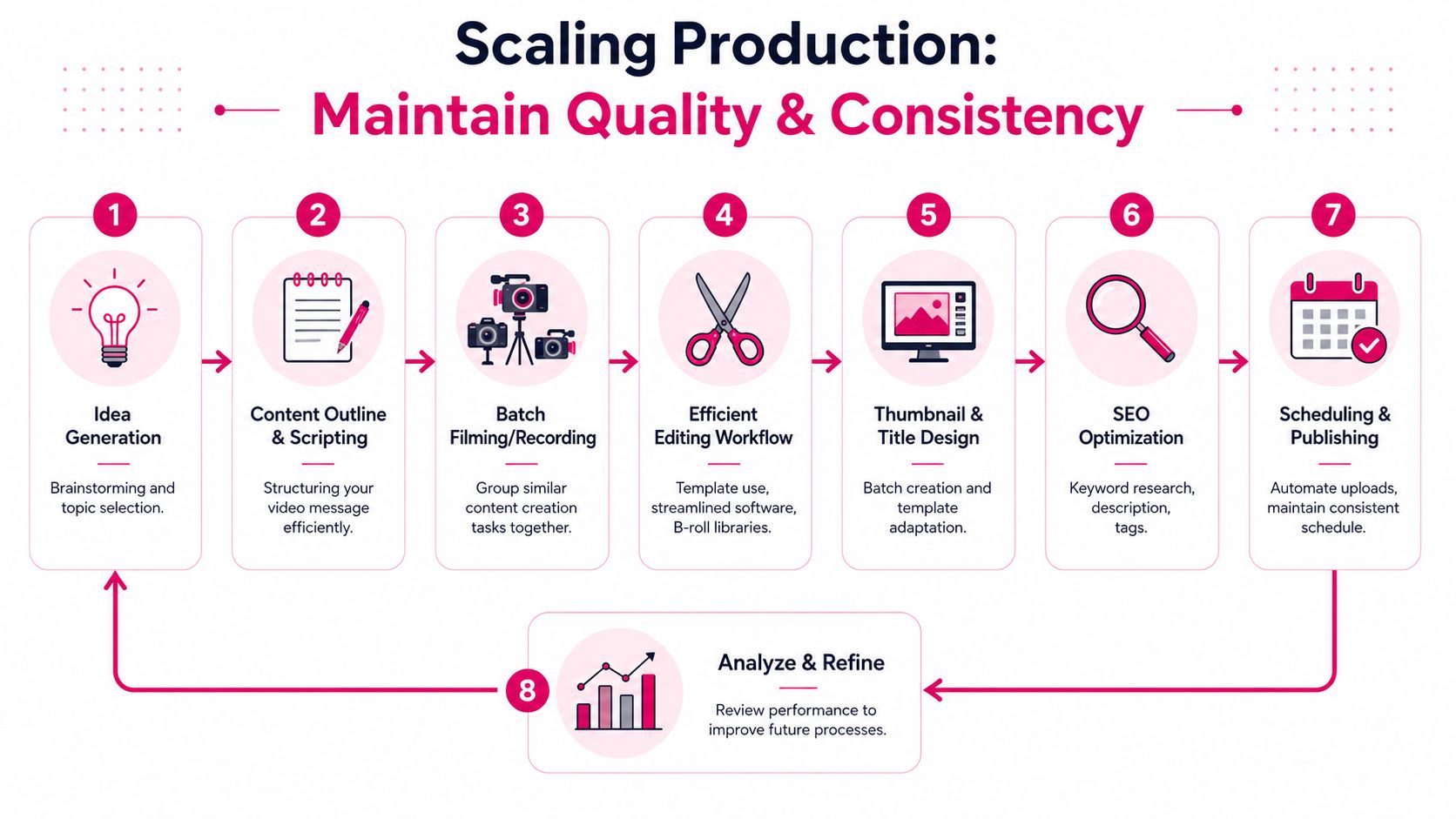
Data summarized in this analysis of first-1000-subscriber growth systems shows that inconsistent production quality, especially in audio, pacing, and visual clarity, suppresses subscribe conversion. The same source notes that channels using standardized editing workflows and brand-aligned graphics see 2–3x higher subscriber retention than channels with fragmented production.
Quality problems look small but compound fast
Creators often focus on the idea and ignore the finish. Viewers don't separate them so neatly.
Common conversion killers include:
- Rough audio: If the sound is distracting, people leave before your value lands.
- Slow pacing: Long pauses, repeated points, and dead air weaken retention.
- Visual inconsistency: Mixed fonts, mismatched graphics, and unclear layouts reduce trust.
- Unclear structure: Good advice buried in a confusing edit still feels amateur.
None of that requires a studio budget. It does require a workflow.
Stop treating editing as an afterthought
The old advice says you should do everything yourself at the beginning. That's sometimes useful for learning. It's not always useful for growing.
If editing is the bottleneck, then editing is not a side task. It's a growth constraint. The same is true for thumbnails, short-form clipping, audio cleanup, motion graphics, and review cycles. When those pieces stay inconsistent, the channel keeps resetting the viewer's trust.
A scalable production system usually includes:
| Production area | What standardization improves |
|---|---|
| Editing templates | Faster turnaround and more consistent pacing |
| Thumbnail style | Stronger recognition across uploads |
| Audio processing | Cleaner viewer experience |
| Motion graphics | Better clarity without reinventing visuals |
| Review workflow | Fewer delays and less confusion |
Outsourcing isn't an admission that you can't do the work. It's a decision to protect the part of the work that only you can do.
That might be writing better hooks, improving delivery, researching smarter topics, or spending more time on-camera. The founder-operator trap on YouTube is doing every task personally, even after those tasks start reducing output quality.
The right question isn't cost
The better question is this: does your current process let you publish at a steady pace without lowering quality?
If the answer is no, then the system needs redesign. Some creators solve that with batching. Some use templates. Some hand off technical production so they can stay focused on strategy and performance. What matters is consistency the viewer can feel.
A channel grows faster when every upload looks like it belongs to the same serious creator.
Tracking Progress and Crossing the 1000 Subscriber Finish Line
Most creators obsess over views. Views matter, but they're incomplete.
If your goal is the first 1,000 subscribers, the metric that deserves the closest attention is which videos generate subscribers. That's where your future strategy lives. Not in the loudest upload, but in the one that turns a viewer into a returning audience member.
Research summarized in this vidIQ analysis of upload counts to 1,000 subscribers indicates that most creators reach the milestone after publishing more than 150 videos, while a meaningful group gets there between 40 and 149 uploads. That makes one thing very clear. The journey is usually a body of work, not a single breakout moment.
What to watch inside analytics
Three signals matter most:
- Audience retention: Did people stay long enough to trust the video?
- Click-through behavior: Did your packaging earn the click in the first place?
- Subscribers by video: Which topics and formats convert?
When one video consistently brings in subscribers, study it closely. Look at the topic, opening, thumbnail style, pacing, and call to action. That video is telling you what your market wants from you.
Use a simple review rhythm
Don't drown in dashboards. Run a practical review after each publishing cycle.
- List your top subscriber-driving videos
- Identify what they share
- Make the next video closer to that pattern
- Cut what isn't converting
Patience thus becomes strategic, not merely passive. If most creators need a substantial library before they cross the line, then every upload has two jobs. It should help viewers now, and it should teach you what to repeat next.
If you're serious about how to get 1000 subs on YouTube, stop hunting for a miracle upload. Build a channel that learns with every release.
If publishing consistently is your bottleneck, Your Video Editor can help you turn strategy into output. The service supports long-form edits, Shorts, thumbnails, motion graphics, audio cleanup, and brand-aligned assets with structured review workflows, clear turnaround times, and revision support. That makes it easier to keep your channel on schedule without letting quality slide.