You can hit a video that takes off, watch the view count climb, and still find the monetization tab greyed out. That's the part most new creators don't expect. TikTok doesn't run on one simple “get big, get paid” rule anymore; it runs on several different programs with different gates, and the fastest way to get unstuck is to know which door you're trying to open.
A creator with 1,200 followers is not in the same situation as a creator with 12,000 followers and 90,000 recent views. One may already have access to some earning paths, while the other is still chasing the main ad-revenue program. If you want a quick comparison of where creators tend to earn best across platforms, this breakdown on which pays best for creators is a useful companion, but the true win on TikTok is matching your current stage to the right monetization path.
If your videos are getting attention but cash isn't showing up yet, the problem usually isn't effort. It's fit. A lot of creators keep grinding toward one threshold while ignoring the programs that were already open to them, or they apply for the wrong one and get denied for a rule they never knew existed. For creators trying to make a breakout clip do more than just rack up views, this guide can sit beside a practical workflow like how to make a video viral.
Table of Contents
- Why a Viral Video Is Not Enough Anymore
- The Main TikTok Monetization Programs at a Glance
- The 10,000 Followers and 100,000 Views Rule Explained
- Monetization Paths That Start Before 10,000 Followers
- Country, Age, and Account Rules That Gate Everything
- How to Apply and What the Approval Timeline Looks Like
- How Consistent Publishing and Professional Editing Move the Needle
- Your 30-Day Plan and Quick Answers to Common Questions
Why a Viral Video Is Not Enough Anymore
A creator posts a video on Monday. By Wednesday, it's crossing into unfamiliar territory, comments are flooding in, and the profile visits are climbing. Then the creator opens TikTok's tools and sees that monetization still isn't available. That mismatch feels unfair, but it's usually just the wrong expectation, because a single hit doesn't grant access to every program on the app.
TikTok's earning system now looks more like a set of separate lanes than one big tunnel. Creator Rewards pays on qualifying long-form views, LIVE Gifts pays during broadcasts, TikTok Shop affiliate pays commissions on sales, Subscriptions pay from fan support, and Creator Marketplace connects you with brands rather than paying you directly from views. If you want a general walkthrough of the main earning paths, the idea is similar to what you'll see in an overview of the Creator Rewards Program, but the important thing is not the label. It's knowing which rule set belongs to which lane.
Think in doors, not dreams
A creator who makes tutorial clips may care about long-form ad revenue. A fashion creator with a smaller but active audience may get more traction from affiliate sales. A livestream-focused creator may be better off building toward LIVE-based monetization first. Those are not competing strategies, they're different doors inside the same stadium.
Practical rule: stop asking, “How do I monetize TikTok?” and start asking, “Which TikTok monetization requirements apply to the program I want?”
That shift matters because many creators delay income while waiting for the one threshold they heard about on a short-form advice video. Some paths open earlier. Some need a different kind of content. And some, like brand-deal tools, reward audience fit more than raw scale. The right move is to map the program first, then build toward the threshold that directly matches it.
The Main TikTok Monetization Programs at a Glance
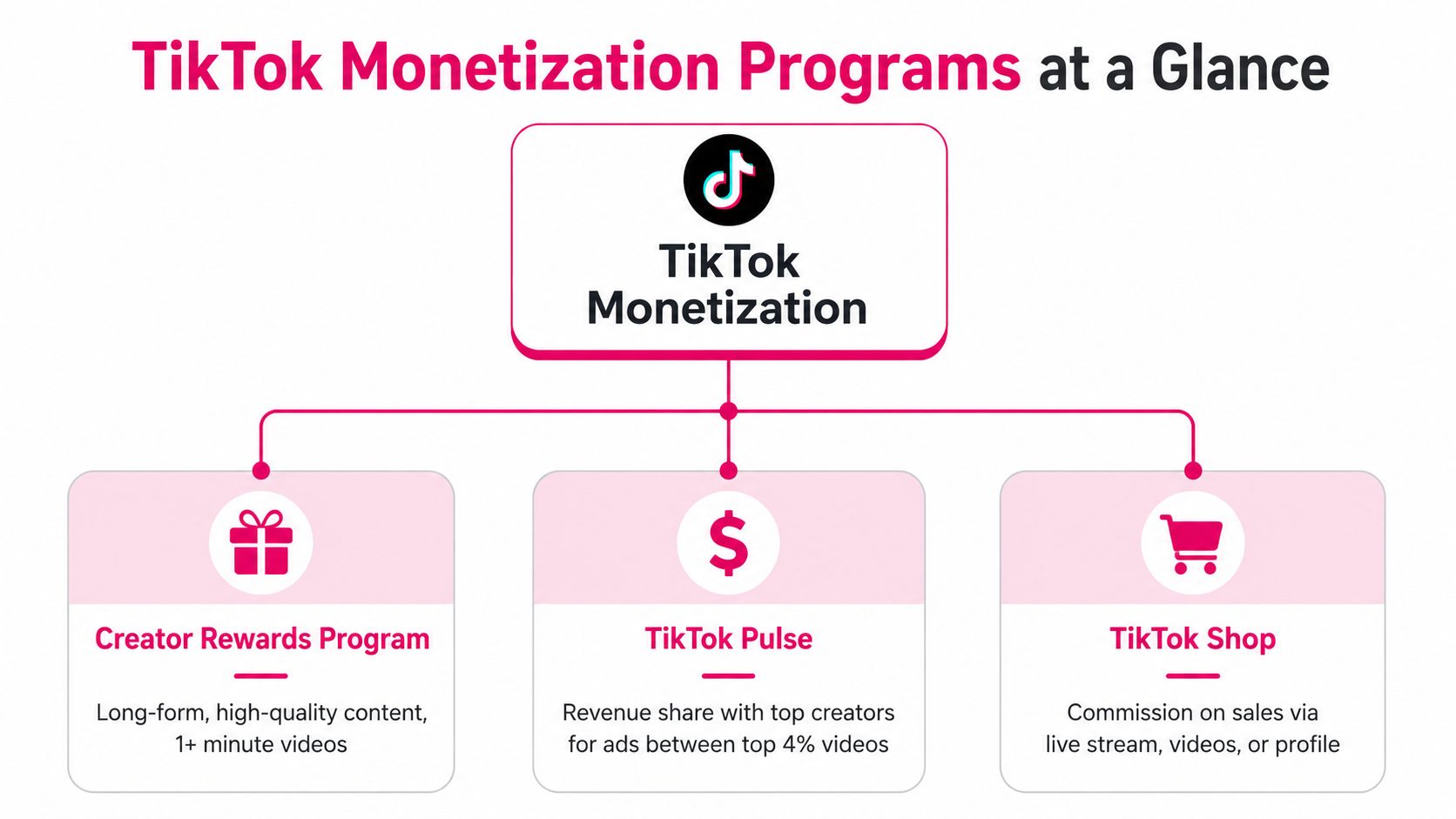
A creator can have a healthy audience and still be looking at the wrong monetization lane. TikTok's setup makes more sense when you separate revenue-share programs from access-based programs. Revenue-share programs pay because your content or live session earns money inside a system TikTok controls. Access-based programs open a route to income, but the money itself comes from a sale, a fan, or a brand relationship. That difference matters because the account can be inactive in one program and still be earning in another.
TikTok's monetization stack works like a set of separate entrances, each with its own rules. One path pays for content performance. Another lets viewers tip during live sessions. Another places products next to your videos so you can earn commissions. Another connects you with brands. The entry requirements are not the same, so a creator should match the program to the type of content first, then check the threshold.
What each program is for
Creator Rewards is the newer version of TikTok's old Creator Fund. It is built for longer videos and pays based on qualified performance, which is why the old habit of posting anything and hoping for the best stopped working. If you want a broader sense of how that payout path is usually discussed, how TikTok pays for million-view videos helps frame the ad-revenue side.
LIVE Gifts is more direct. Go live, build trust in real time, and viewers can send virtual gifts. TikTok Shop affiliate is commerce-first, so you promote products and earn when sales happen. Subscriptions rely on fan loyalty, badges, and exclusive perks. Creator Marketplace is a brand connection layer, not a direct ad-revenue pool.
For a closer look at the creator payout side, explore the Creator Rewards Program.
Why this matters before you chase thresholds
A lot of creators get stuck because they assume the 10,000-follower target is the starting line for every kind of monetization. It isn't. Some paths are available earlier, some require different content formats, and some care more about live engagement or product fit than follower count. A creator with 1,200 followers may already be eligible for one lane, while another lane still requires much more growth.
Start with the earning model, not the vanity metric. A tutorial creator may be better suited to long-form payout rules. A fashion creator with a smaller but active audience may get more from affiliate sales. A livestream-focused creator may have a faster path through live-based monetization first. Choosing the right lane early saves a lot of wasted posting.
The 10,000 Followers and 100,000 Views Rule Explained
The headline rule exists, but creators often hear it in a sloppy way. For TikTok's main creator payout program in major markets, current guidance commonly cites 10,000 followers and 100,000 valid video views in the last 30 days, along with being 18+, in good standing, and on a personal or creator account, not a business account, as explained in Proxidize's TikTok statistics guide and Flowshorts' monetization requirements article. Multiple 2026 guides also note that the qualifying videos need to be longer than 1 minute.
The 30-day window is the part people miss
This is not a lifetime view count. It is a rolling 30-day window, which means older traffic drops out as new days replace it. That changes the reading of the rule. A creator cannot rely on a one-time spike from last month and assume the account stays eligible forever. The dashboard looks at recent activity, not past success.
The math makes that easier to see. To clear 100,000 views in 30 days, a creator needs roughly 3,333 views per day on average. A viral post can help, but it usually will not be enough on its own unless it lifts the account's rolling average for weeks, not just a weekend.
A viral clip can help you qualify, but consistency keeps you there.
Why watch time still matters if it is not in the headline
TikTok does not treat every view as equally useful. The platform uses quality signals to decide which views are counted as valid and which ones get suppressed or ignored in practice. That is why poorly retained videos often fail to move the eligibility needle even when the view number looks decent. If people drop off early, the content stops helping the account's recent performance.
The longer-video requirement is the structural reason the newer model pays better than the old one. TikTok is steering creators toward content that keeps people watching, not just scrolling. The rule is less about a single threshold and more about format. Longer videos create more room for watch time, and watch time is what the system wants.
Monetization Paths That Start Before 10,000 Followers
A lot of guides act like TikTok money starts only after 10,000 followers, which leaves smaller creators thinking they're locked out. That's not how the platform works. Some paths are open earlier, and they're worth treating as real income lanes, not side notes.
The clearest example is LIVE Gifts. Sources in the brief note that this commonly opens around 1,000 followers, once LIVE access is available, and it's a direct support model rather than an ad-revenue share. TikTok Shop affiliate is different again, because it's tied to product promotion and sales, not to the Creator Rewards gate. Subscriptions and Creator Marketplace also have their own rules and don't depend on the same view threshold as Creator Rewards. For a useful brand-deal angle, this guide by SponsorRadar is a solid companion when you start thinking about sponsorships as a separate path.
Comparison table
| Program | Min followers | Other requirement | Payout model |
|---|---|---|---|
| LIVE Gifts | Lower than Creator Rewards, often around 1,000 | LIVE access, account in good standing | Viewer gifts during streams |
| TikTok Shop affiliate | Can start before 10,000 | Product promotion and sales setup | Commission on sales |
| Subscriptions | Varies by program access | Fan support and perk setup | Recurring fan payments |
| Creator Marketplace | Often around 10,000 for brand-facing access | Active posting and account health | Brand deals, not TikTok ad revenue |
| Creator Rewards | 10,000 | 100,000 views in 30 days, 18+, eligible region | Revenue share on qualifying long videos |
Why this changes the growth strategy
A creator with 1,500 followers doesn't need to sit idle waiting for the big gate. They can build live habits, test products, and learn what their audience buys. That early monetization can fund better production and give the account more room to grow. Meanwhile, the push toward Creator Rewards can continue in the background.
The mistake is treating these paths like substitutes. They're usually complementary. One creator may use affiliate links to monetize now, while still aiming for the larger ad-revenue threshold later. That's the smarter path because it turns the wait into a working business instead of a pause.
Country, Age, and Account Rules That Gate Everything
Even when the numbers look right, eligibility can still stop at the door. TikTok's monetization tools are not available everywhere, and not every account type is eligible for every program. That's why two creators with identical follower counts can get different answers when they open the tools menu.
The checklist that decides whether you can apply
- Region: The main creator payout program is available in selected markets such as the US, UK, Germany, France, Japan, South Korea, Mexico, and Brazil, based on the verified data and the regional lists in the research brief.
- Age: Most paid programs require you to be 18+.
- Account type: A personal or creator account is commonly required for Creator Rewards, while business accounts can be excluded from some programs.
- Good standing: Accounts with guideline issues, copyright problems, or under-review flags can be blocked even if they hit the numbers.
Why the fine print matters more than creators expect
The account type rule catches a lot of people. Some creators build on business profiles because they assume every “professional” account is better. On TikTok, that can be the wrong setup for certain payout paths. If the monetization tab never appears, account type is one of the first things to check.
Region is the other common blocker. A creator can read every rule correctly and still be in a market where the program hasn't opened yet. That isn't a content problem, it's a geography problem. Age works the same way. If the account holder is under 18, many direct payout options stay closed.
Good standing is broader than a single strike. It covers repeated policy violations, copyright issues, and flags that make TikTok hesitant to attach money to the account. The safest approach is simple: keep the account clean before you apply, not after you get rejected. That saves time and keeps your monetization paths open.
How to Apply and What the Approval Timeline Looks Like
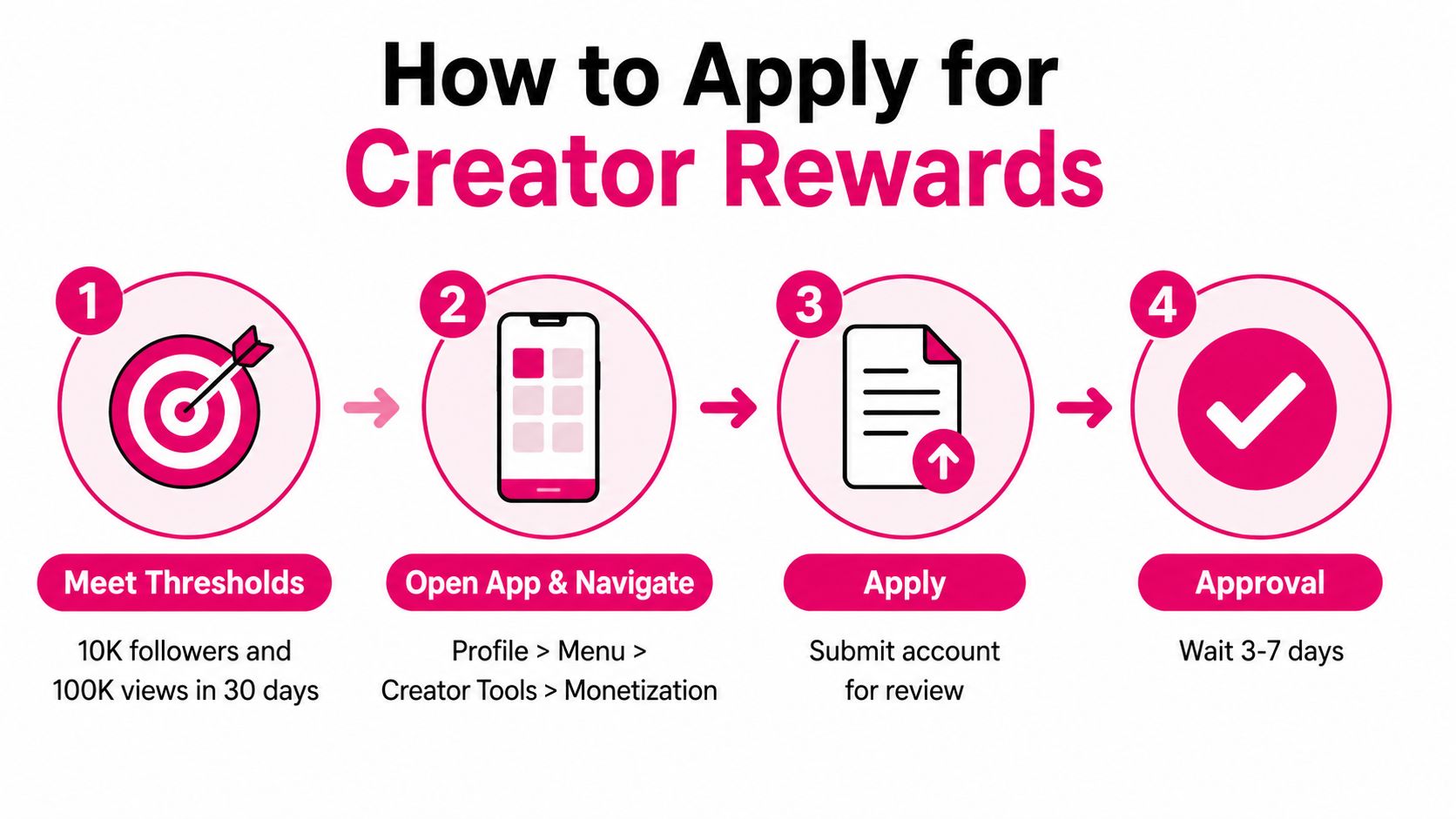
Once the account qualifies, the application process is mostly inside the app. You open Creator Tools, find the monetization section, toggle on Creator Rewards or the relevant program, agree to the terms, and link payout details. From there, TikTok reviews the account and the setup before approval.
The basic application flow
- Meet the thresholds. Hit the follower, view, age, and region rules first.
- Open Creator Tools. Go to your profile menu inside the TikTok app.
- Choose the monetization option. Select the Creator Rewards or Creativity Program entry if it appears.
- Complete review and payout setup. Add the tax and payment information TikTok asks for.
What the review is actually checking
The review process usually looks at whether the account matches the person applying, whether tax and identity details are complete, and whether the account's recent views look organic. If the details don't line up, the application stalls. If the account type is wrong, it can stall before the review really starts. If the tax form isn't finished, the first payout can get delayed even after approval.
The brief's verified data doesn't give a fixed universal timeline, so the safest way to think about it is this: approval is not instant. Some accounts move faster than others, but there's usually a delay between meeting the threshold and seeing money hit the payout method. That delay is often about setup, not content quality.
The two most common stalls are predictable. One is applying before converting a business account to the eligible account type. The other is leaving tax information incomplete. Both are avoidable if you check the basics before you tap submit.
How Consistent Publishing and Professional Editing Move the Needle
A viral post helps, but a posting habit is what keeps the rolling window alive. If you post every other day, you're creating repeated chances for the algorithm to distribute videos into different audience pockets. That matters more than people think, because the 100,000 views in 30 days requirement is a moving target, not a one-time badge.
Why cadence beats one-off luck
A creator who only publishes when inspiration hits usually leaves too much of the month unused. A creator who posts on a steady schedule keeps feeding the system new material to test. That creates more opportunities for one video to catch, and also, more opportunities for several videos to contribute to the rolling total.
Editing quality starts to matter in a practical way. If the opening seconds are weak, viewers leave early. If the pacing drags, the account loses the very watch behavior that supports eligibility. Better cuts, tighter hooks, captions, and cleaner vertical framing all help the video hold attention longer.
Short version: don't edit for style alone, edit to stop viewers from dropping before the video has a chance to work.
Professional editing is useful because it fixes the parts creators often stop noticing. A raw clip may contain the idea, but the first three seconds decide whether that idea gets seen. That's why tools and teams that specialize in short-form vertical work can change the outcome without changing the creator's voice. If you're comparing editing support options, this guide to the best TikTok video editors is a practical place to start.
The goal isn't to “hire an editor and go viral.” The goal is to make each post less likely to leak attention. That keeps more views in the pipeline, which keeps the 30-day counter alive, which makes Creator Rewards much more realistic.
Your 30-Day Plan and Quick Answers to Common Questions
Start with the account, not the video. Check whether you're in an eligible region, confirm your account type, and make sure your age and standing don't block you. Then pick the monetization path that matches your current size. A small but engaged account should look hard at live support or commerce, while a larger account can aim at Creator Rewards.
A simple 30-day plan
- Audit your setup: Confirm region, age, and account type before you build around the wrong path.
- Choose one primary earning lane: Creator Rewards, LIVE Gifts, Shop affiliate, Subscriptions, or brand deals.
- Publish on a schedule: Keep enough videos going out to support the rolling 30-day view window.
- Improve the first seconds: Tight hooks and cleaner edits matter because early drop-off hurts performance.
- Review analytics weekly: Watch whether recent videos are contributing to the total.
Quick answers creators keep asking
How long does payout approval take? It's not instant, and it often depends on review plus tax and identity setup. TikTok's process can take longer if your information isn't complete.
What happens if a video gets removed? That can hurt account standing and may affect eligibility if the violation is serious enough. The safest move is to keep content original and policy-safe.
Does a brand deal through Creator Marketplace count toward the 100,000-view threshold? No. That threshold is tied to the qualifying view requirement for Creator Rewards, not to brand-deal activity.
Why doesn't the Creator Rewards toggle appear? The most common reasons are region limits, account type issues, or not meeting the follower and rolling view thresholds yet.
If you want a clearer path from “posting regularly” to “earning consistently,” don't wait for the right video to solve everything on its own. Tighten the setup, choose the right program, and treat the first month like an operating system for growth. If you're ready to offload the editing burden and keep your TikTok output consistent, talk with Your Video Editor and build a workflow that helps you publish on schedule.