You're probably asking because the job looks simple from the outside. A creator records a video, posts it, and waits for views. Maybe they answer a few comments and make money from brand deals.
That's the fantasy version.
The answer to what a content creator does is much bigger. A creator researches ideas, studies audience behavior, writes, records, edits, publishes, tests headlines, reviews analytics, manages a community, and makes business decisions about time, money, and growth. In practice, a serious creator operates less like a hobbyist and more like a small media company.
That's also why so many aspiring creators get stuck. They think the job is mostly about being creative, when a lot of the work is largely operational. The people who last usually learn one important shift early. They stop treating content creation like “making posts” and start treating it like running a business.
Table of Contents
- The Modern Content Creator More Than Just a Hobby
- The Six Core Responsibilities of a Content Creator
- How the Creator Role Changes by Platform
- A Day in the Life of a Full-Time Creator
- The Creator Bottleneck Why Professional Editing Is a Growth Strategy
- Monetization Career Paths and Building Your Team
- Conclusion From Creator to Creative CEO
The Modern Content Creator More Than Just a Hobby
A lot of people still picture creators as people who “just post online.” That idea is outdated. A modern creator is often the strategist, on-camera talent, producer, editor, publisher, marketer, and business owner all at once.
That shift isn't just cultural. It shows up in labor and platform behavior. In March 2023, LinkedIn reported that “Content Creator” was the top emerging job title in the United States, with a 115 percent increase in people listing that role on their profiles compared to the previous year, and more than 1.2 million people in the U.S. identifying as content creators on the platform, according to LinkedIn's report on the emerging role of content creator.
That matters because it reframes the job. If more than a million people identify with the role, then “creator” can't be reduced to posting selfies or recording a quick clip. It includes educational YouTubers, business podcasters, course creators, streamers, newsletter writers, short-form video publishers, and niche experts building audiences around a clear topic.
Practical rule: If your content has a goal, an audience, and a publishing system, you're already operating more like a business than a hobbyist.
Readers often get confused here because the word creator sounds broad, even vague. That's fair. The label covers many formats. But the core job stays consistent. A creator makes media designed for an audience and distributes it through digital platforms with a purpose. That purpose might be growth, trust, sales, education, entertainment, or a mix of all four.
A simpler way to understand this is:
| Creator myth | Professional reality |
|---|---|
| “They post when inspired” | They work from a repeatable content system |
| “They just film videos” | They research, package, edit, publish, and measure |
| “They're internet personalities” | They're building a media asset and a brand |
| “Success is luck” | Success usually comes from consistency and iteration |
The biggest mindset shift is this. A creator's product is not only the video, post, or episode. Their real product is a reliable system for producing attention and trust over time.
The Six Core Responsibilities of a Content Creator
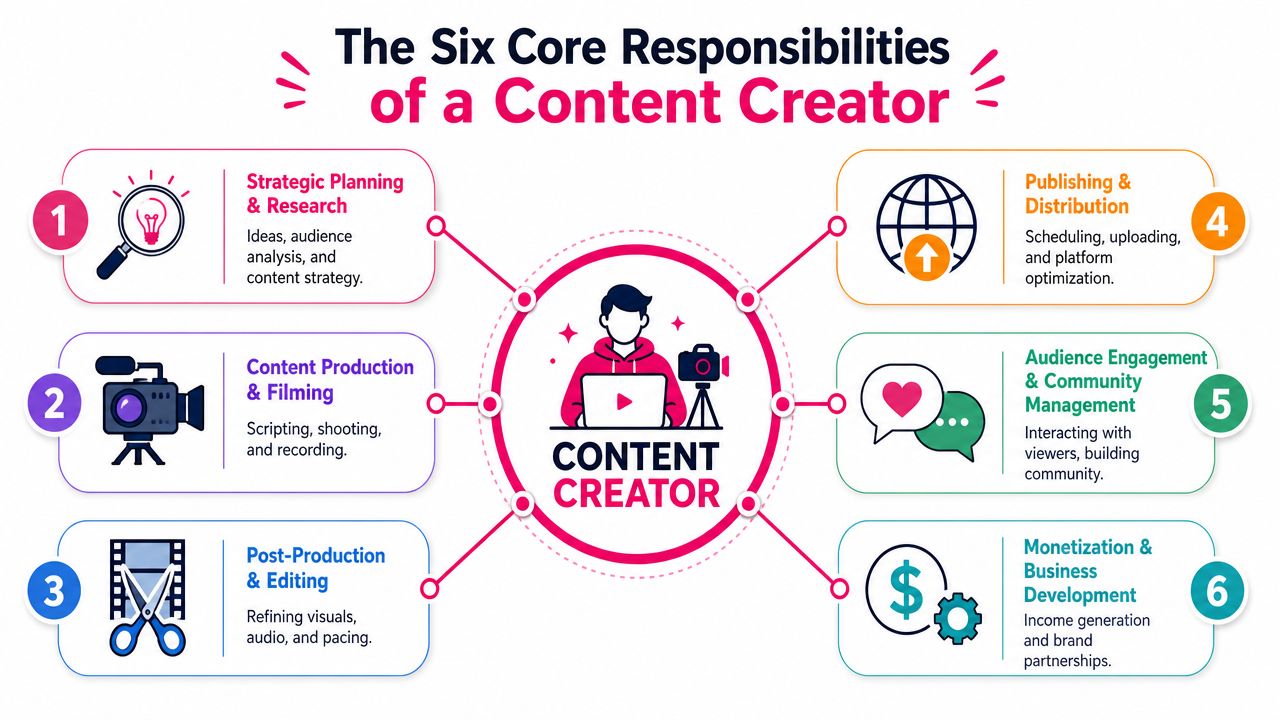
Strategy comes before posting
The best creators don't start by asking, “What should I upload today?” They start with audience questions, platform trends, search demand, and business goals. That's strategy.
This can mean using tools like Google Trends to spot interest, reviewing competitor formats, building a content calendar in Notion, or deciding whether a topic should become a YouTube video, Reel, blog post, or email. According to Coursera's overview of digital content creator responsibilities, creators who conduct keyword research with tools like Google Trends can achieve 30% higher search visibility, and a 15% increase in average view duration can correlate with a 22% rise in subscriber growth on YouTube.
If you're early in the process, a guide to skills needed to become a YouTuber can help you see how strategy and production skills connect in real-world creator work.
Production turns ideas into raw material
Once the idea is clear, production begins. This is the part people usually notice first. Writing a script or outline. Setting up lights. Recording A-roll. Capturing B-roll. Doing multiple takes. Checking sound. Making sure the footage matches the platform.
Production sounds glamorous until you do it yourself. Then you realize how much of it is logistics.
A business creator might spend one day batching several videos. A podcaster might record interviews and solo episodes in the same session. A fitness creator may need to think about camera angles, environment noise, wardrobe continuity, and how to visually teach a movement.
Editing shapes the experience
Here, raw material becomes watchable.
Editing isn't only about trimming mistakes. It controls pace, emotion, clarity, and retention. A creator or editor cuts dead space, adds captions, balances audio, inserts supporting visuals, color-corrects footage, and decides where viewers may lose interest.
A great idea can still fail if the pacing is slow, the sound is distracting, or the structure makes people work too hard to follow it.
This is also where many creators underestimate the workload. They think the creative work ends after filming. In reality, post-production is often where the content becomes professional.
Publishing is a technical job too
Uploading is not the end. It's another layer of execution.
A creator needs to write titles, descriptions, metadata, tags where relevant, thumbnails, captions, chapters, and calls to action. They also need to match the platform's format expectations. Long-form YouTube, Shorts, Reels, podcasts, and blog posts all need different packaging.
Publishing includes choices like:
- Title quality: A weak title can bury a strong video.
- Thumbnail clarity: A confusing visual lowers curiosity.
- Scheduling discipline: Inconsistent publishing makes growth harder.
- Platform fit: The same idea often needs different editing and framing on each channel.
Analytics create the feedback loop
Creators don't review numbers just to feel good or bad. They use analytics to decide what to make next.
They look at watch time, retention drop-offs, click-through behavior, subscriber conversion, comments, saves, and search terms. Then they adjust. Maybe the topic was strong but the opening was weak. Maybe viewers loved the idea but clicked away because the title overpromised.
This loop matters because content creation is iterative. Every post teaches the creator something.
Community turns viewers into followers
A creator doesn't only publish to an audience. They build a relationship with one.
That means replying to comments, noticing recurring questions, collecting feedback, testing new topics based on audience interest, and protecting the tone of the community. For some creators, this also includes email newsletters, Discord groups, live streams, or private memberships.
Here's a clean way to see the full job:
- Research the audience
- Develop an idea
- Produce the content
- Edit for clarity and retention
- Publish with strong packaging
- Review performance and engage with viewers
That cycle repeats. That's the job.
How the Creator Role Changes by Platform
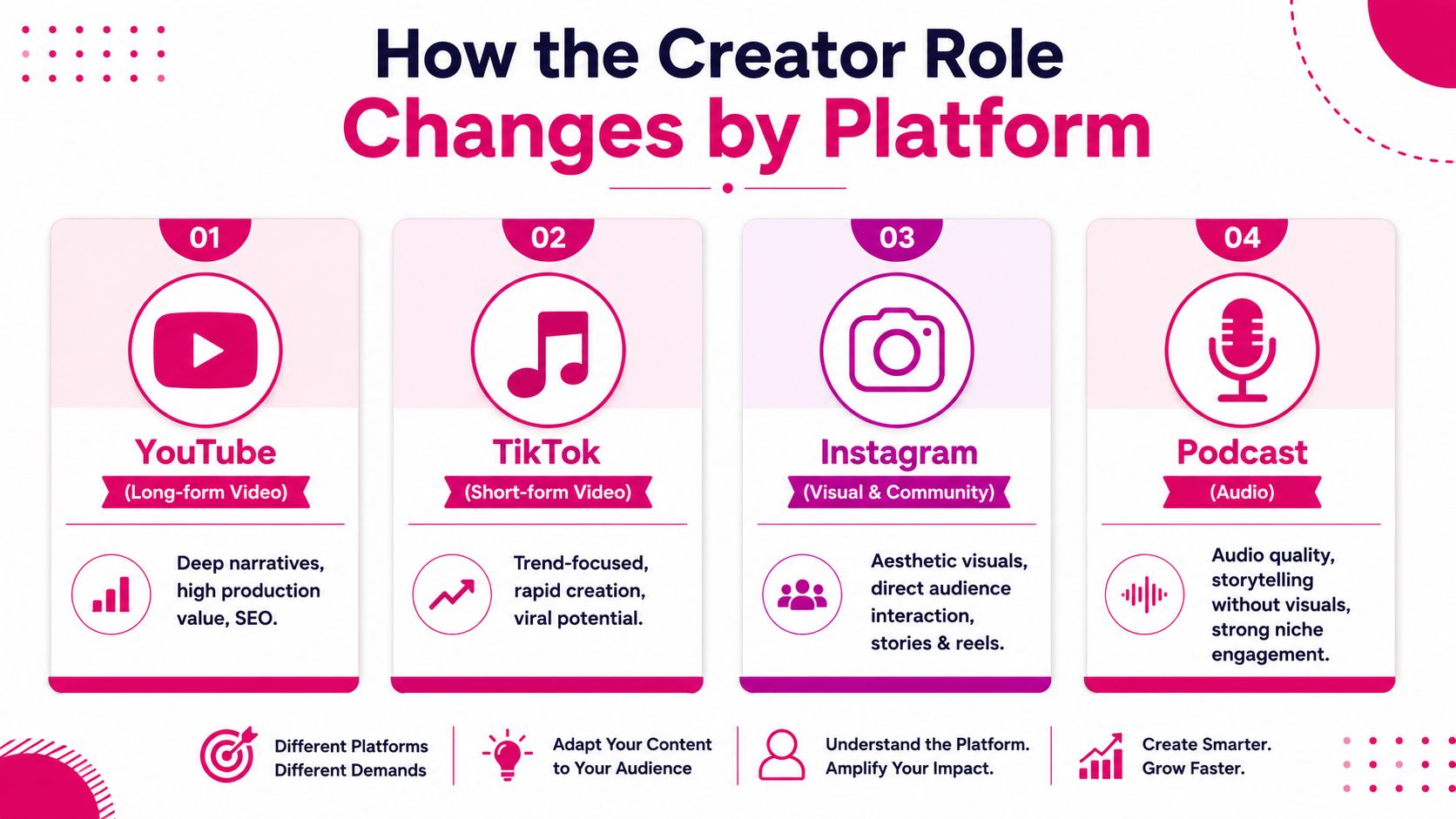
A creator on YouTube does not work the same way as a creator on TikTok. The role overlaps, but the operating environment changes. That means the same person may need different instincts, production methods, and publishing habits depending on where they show up.
YouTube rewards depth and packaging
YouTube usually asks for more planning. Long-form creators often need stronger outlines, clearer narrative structure, and better search packaging than creators who publish mostly reactive short clips.
Platform optimization is a real part of the job. According to the Video Content Creator Job Description reference, YouTube videos with titles under 60 characters and high-contrast thumbnails achieve 34% higher click-through rates. That means a YouTuber isn't only making the video. They're also making the decision architecture around the video.
A YouTube creator often thinks about:
- Search behavior: What is the viewer actively looking for?
- Narrative shape: Does the story or lesson sustain attention?
- Thumbnail promise: Is the packaging specific enough to earn the click?
- Session value: Will this video lead people to watch another one?
TikTok and Shorts demand speed
Short-form platforms are less forgiving. The hook has to land immediately, the visuals need to make sense without setup, and the pacing has to be tighter.
The same source notes that TikTok demands a compelling visual hook within the first 0.5 seconds, or creators risk a 41% drop in retention past the 30-second mark. That's why short-form creators obsess over the opening frame, first line, and on-screen text.
A good TikTok creator often works like a rapid-response producer. They watch trends, test formats quickly, and adapt ideas fast. They also know that a short video isn't just a clipped-down YouTube video. It needs its own rhythm.
On short-form platforms, the first moment is not an introduction. It is the audition.
Instagram is part media brand part relationship channel
Instagram creators live closer to brand identity and audience connection. Visual consistency matters more. So does how the feed, Stories, DMs, comments, and Reels support one another.
A fashion creator may care about aesthetic cohesion. A coach may use Stories to answer objections and Reels to reach new people. A food creator may combine polished carousels, personality-driven Stories, and short recipe videos.
The work is less about one single “piece of content” and more about whether the account feels coherent. Instagram often asks a creator to act like a brand manager as much as a publisher.
Podcasts and blogs play a different game
Podcasters create without visual support, so the burden shifts to voice, structure, pacing, and audio quality. A weak mic setup or messy edit is more obvious when audio is the entire experience.
Bloggers work in a different medium entirely. They need topic depth, readable structure, search intent awareness, examples, and strong formatting. A blog creator has to think about subheadings, scannability, and whether the article solves the exact problem the reader searched for.
Here's a simple comparison:
| Platform | What the creator emphasizes most |
|---|---|
| YouTube | Story structure, thumbnails, search packaging |
| TikTok | Hooks, speed, trend adaptation |
| Visual brand, trust, daily audience interaction | |
| Podcast | Audio clarity, conversation flow, niche authority |
| Blog | Search intent, writing clarity, depth |
So when people ask what does a content creator do, the best answer is not one job description. It's a family of roles shaped by platform rules.
A Day in the Life of a Full-Time Creator
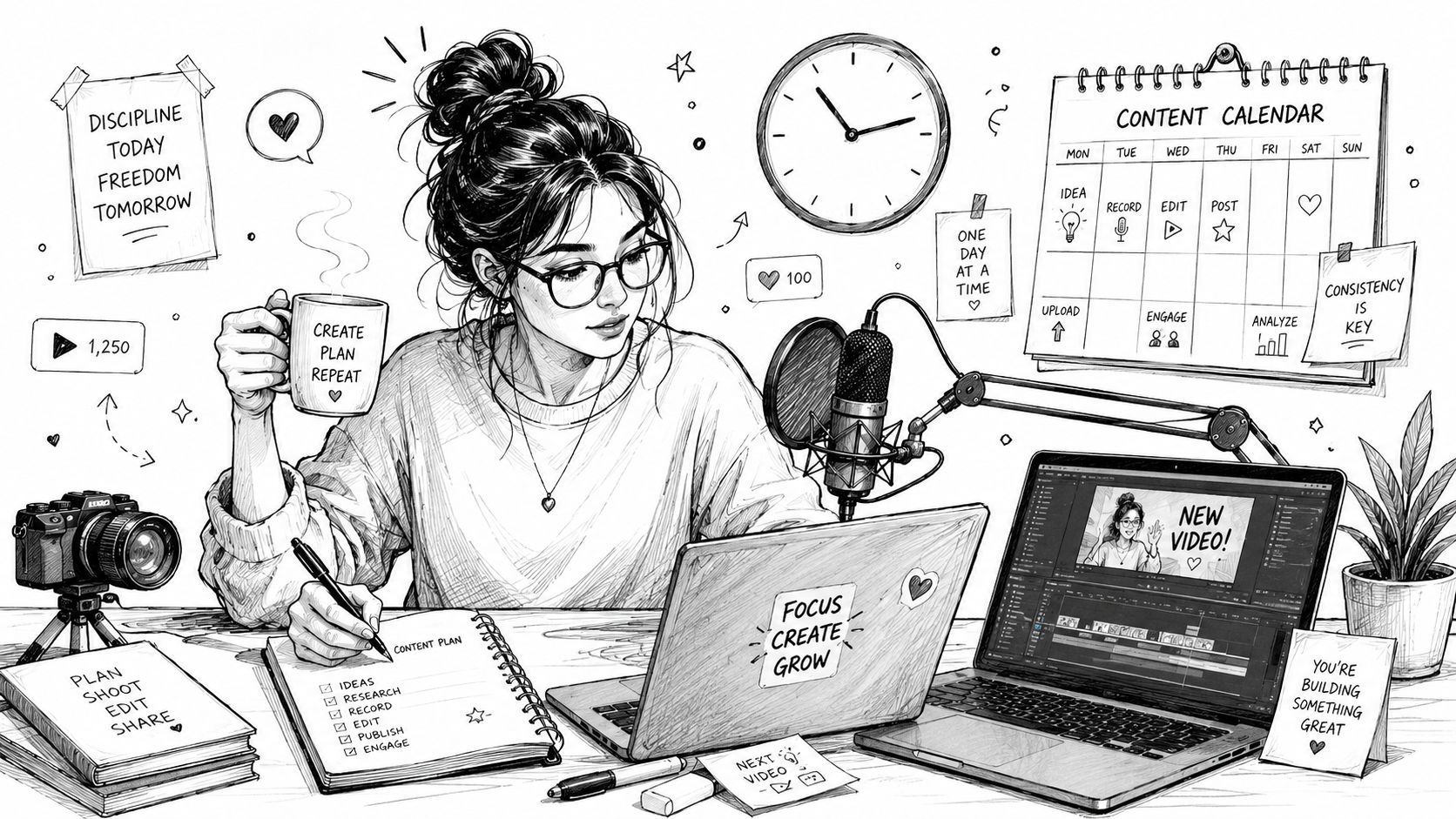
Morning is for decisions
A full-time creator's day often starts at a desk, not in front of a camera.
The morning might begin with checking yesterday's video performance, scanning comments for audience questions, reviewing email, confirming a brand brief, and adjusting the week's production plan in Notion or Google Calendar. If a topic underperformed, the creator may rewrite an upcoming title angle or change the hook for the next shoot.
Then comes writing. Not always a full script. Sometimes it's a bullet outline, a shot list, or a talking-point doc. The point is to reduce friction before recording.
Afternoon is for production
Once the planning is done, the room changes. Lights come on. Batteries get checked. The microphone is tested. Camera framing gets adjusted.
A solo creator might record a main video, then switch to vertical framing for Shorts or Reels. They may capture B-roll after the primary take because it's more efficient to stay in production mode. If they teach, they'll also record screen captures, demos, or product shots.
This part can look smooth online. In reality, it includes retakes, file transfers, background noise problems, and constant quality checks.
A creator's day is full of context switching. You go from writer to presenter to producer in a few hours.
Evening is where the business side shows up
After filming, the technical side takes over. Files need to be organized. Footage may need proxy generation, syncing, or handoff to an editor. Thumbnails need to be selected or briefed. Captions and descriptions may need drafting. If the creator edits personally, the longest block of focused work begins.
The end of the day may include publishing prep, approving revisions, reviewing a sponsorship contract, or outlining tomorrow's content. For a full-time creator, the “creative” day usually ends with administrative work.
A realistic creator day often includes all of these:
- Content planning: Topic selection, scripting, research
- Production tasks: Recording, lighting, audio, B-roll
- Post-production work: Review footage, edit, revise, export
- Business admin: Invoices, partnerships, scheduling, email
- Audience work: Comments, DMs, community responses
That's why consistency is hard. The work is varied, mentally demanding, and easy to underestimate.
The Creator Bottleneck Why Professional Editing Is a Growth Strategy
The first real bottleneck for many creators isn't ideas. It's post-production.
A creator can research, script, and film in a relatively short window, then lose momentum in the edit. Multi-cam syncing, audio cleanup, color correction, captions, motion graphics, exports, and revision cycles pile up fast. The result is a common pattern. Good footage sits in a folder while the publishing calendar slips.
The hidden cost of doing everything yourself
The “creative CEO” mindset matters. A CEO doesn't ask only, “Can I do this task?” They ask, “Should I still be doing this task?”
Editing is a perfect example. It's skilled work. It's valuable. But it's also one of the easiest places for a creator to become the bottleneck in their own company. If filming takes one block of time but editing drags across several days, the creator's output becomes constrained by post-production capacity.
That has second-order effects:
- Publishing gets inconsistent
- Ideas take longer to reach the audience
- Energy shifts from creating to fixing
- Business development gets pushed aside
For creators comparing support options, this is why many eventually look into services that let them hire a video editor instead of keeping every technical step on their own plate.
Why editing changes business outcomes
Professional editing affects more than polish. It can change retention, watchability, and revenue.
A 2025 Nielsen Audience Analytics study found that videos with professional sound design and color grading retained 22% more viewers past the 3-minute mark. A 2024 McKinsey report found that creators using dedicated editors increased their YouTube Partner Program revenue by 35% on average. Those findings matter because they connect editing to audience behavior and monetization, not just aesthetics.
The mechanism is easy to understand. Better pacing reduces drop-off. Cleaner audio reduces friction. Color grading and graphics create a more trustworthy viewing experience. Faster turnarounds help creators publish on schedule.
Here's the later-stage payoff. A creator who stops spending most evenings inside the timeline can spend more time on concept development, collaborations, partnerships, and audience research.
This is worth watching if you're thinking about the production side of creator growth:
When outsourcing becomes a smart move
Outsourcing isn't a shortcut for people who don't care about quality. It's usually what happens when a creator starts caring enough about quality and consistency to protect both.
A good editing workflow gives the creator a repeatable system. Raw footage gets uploaded. Notes are centralized. timestamped feedback reduces confusion. Revisions stay organized. Delivery timelines become predictable. That's operational efficiency.
Key decision: If editing is delaying publishing, editing is no longer just a task. It's a growth constraint.
That's the difference between a creator who is busy and a creator who is scaling.
Monetization Career Paths and Building Your Team
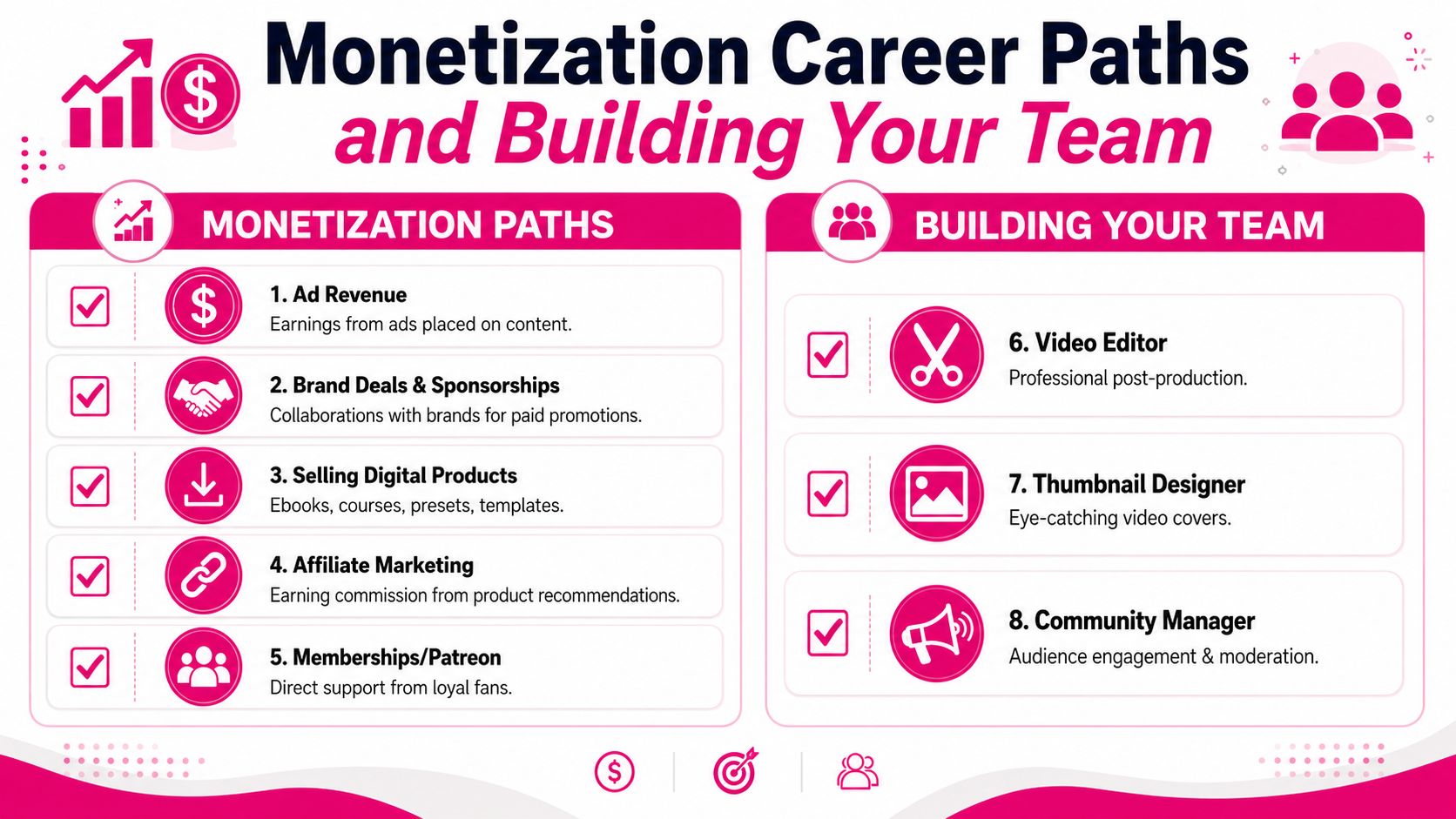
How creators make money
Content creation becomes durable when it connects to revenue, not just reach. That revenue can come from several directions at once. Many creators start with one stream and then layer others on top as the audience matures.
Common models include:
- Ad revenue: Income from platform ad programs tied to watch time or views
- Brand deals: Sponsored segments, dedicated posts, or long-term partnerships
- Digital products: Courses, templates, presets, memberships, or ebooks
- Affiliate income: Commissions from recommended tools or products
- Services: Consulting, coaching, freelance offers, or agency work
If you want examples of how creators structure income around video platforms, this guide on how to make money on YouTube is a useful starting point.
How a creator career expands
Many readers assume the creator path is narrow. It isn't.
Some creators stay solo and profitable. Others turn their audience into a broader company. They may launch a media brand, build a niche education business, create products, run a membership community, or hire support roles and operate like a compact production studio.
That wider ecosystem is real. The U.S. Bureau of Labor Statistics projects 10,400 job openings annually for filmmakers and video editors through 2032, driven in part by the growth of online video platforms, according to the broader BLS outlook summarized in the verified data for this article. That tells you something important. The creator economy doesn't only support creators. It supports editors, designers, strategists, and production specialists around them.
Is it time to hire an editor
This is one of the most useful decisions a growing creator can make. Not because everyone needs a team immediately, but because every creator eventually has to decide what work is core and what work is clogging the system.
Use this checklist thoughtfully:
- You spend more time editing than creating: Your best energy goes into cleanup instead of ideas.
- Your posting schedule slips often: Content is recorded but not published on time.
- You avoid ambitious videos: You keep ideas small because the edit will be too painful.
- Your quality changes from video to video: Audio, pacing, graphics, and polish feel inconsistent.
- Your business work gets delayed: Partnerships, product development, and audience research keep moving to “later.”
- You want to batch content: You need a workflow that keeps production moving after filming ends.
If several of those sound familiar, hiring support isn't premature. It's often the move that lets the business keep growing.
Conclusion From Creator to Creative CEO
A content creator does much more than make posts. They research, package ideas, produce media, review performance, nurture a community, and make business decisions about where their time should go.
That's why the most useful way to understand the role is not “internet personality” or “person with a camera.” It's creative CEO. The creator is building a media asset, an audience relationship, and an operating system at the same time.
Once you see the job that way, one lesson becomes obvious. Growth doesn't come only from making more content. It comes from building a better machine for creating it. For many creators, that means learning when to stop doing every task alone and start delegating the technical work that slows them down.
If you're creating regularly and editing has become the task that keeps pushing everything else back, Your Video Editor can help you offload post-production with professional support for long-form videos, short-form clips, thumbnails, and brand-aligned assets. It's a practical option for creators who want to publish more consistently without carrying the entire editing workload themselves.